Pomodoro vs. Stoplight: Choosing the Right Focus Method
What Pomodoro is
The Pomodoro Technique, created by Francesco Cirillo in the late 1980s, is the most popular time-boxing method in the world. Its core rule is simple: work for 25 minutes, rest for 5, and after four rounds take a longer 15-to-30-minute break. The timer is a countdown; the structure is fixed.
Pomodoro's strength is its rigidity. Because the intervals are fixed, there is nothing to decide. You start the timer, you work, you stop, you rest. The lack of choice is the feature: it removes the negotiation with yourself about how long to keep going.
What the stoplight method is
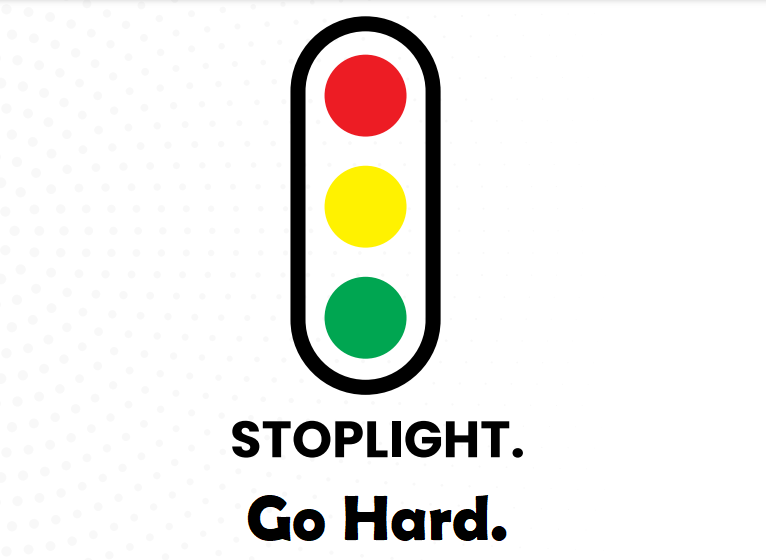
The stoplight method, at its core, is time-boxing with a visual signal instead of a countdown. You set a duration, and as the block progresses the cue shifts from green (deep work) to yellow (wrap up) to red (stop). The intervals are not fixed at 25 and 5 — you choose the length of the block based on the work in front of you.
The trade-off is clear: stoplight gives you more flexibility but asks you to make one decision Pomodoro does not — how long the block should be. In return, you stop watching a number count down and start reading a signal that tells you only what you need to know.
When Pomodoro wins
Pomodoro is excellent for people who struggle to start. The 25-minute interval is short enough that starting does not feel like a commitment, and the fixed structure means there is nothing to negotiate. If your main problem is getting going, Pomodoro's small, rigid blocks are hard to beat.
It is also good for work that is repetitive or that you resist. A 25-minute block of something you do not want to do is bearable; an open-ended session is not.
When the stoplight method wins
The stoplight method suits people who have already solved the starting problem and now struggle with a different one: staying in deep work without constantly checking the clock. If you find yourself watching a countdown — "14 minutes, 13, 12" — you are spending attention on the timer that should be going to the work. A green-yellow-red cue gives you the same information without the clock-watching.
It also suits work that needs longer blocks. Some tasks do not fit in 25 minutes; they need 45 or 90 minutes to reach the state where real progress happens. Pomodoro can be adjusted to longer intervals, but the method's identity is built around the short block. The stoplight method treats the block length as a decision you make, not a rule you follow.
You do not have to choose
These methods are not rival religions. Many people use Pomodoro for tasks they resist and a longer visual-cue block for tasks they want to dive into. The principle underneath both is the same: give the work a boundary, honor the boundary, and rest between blocks. Whichever label you use, the mechanism is what matters.
The best focus method is the one you will actually use on a Tuesday when you are tired and behind. Try each for a week. Notice which one you resisted less, not which one felt more virtuous. The one you resisted less is the one that will still be running in month three.